

Last Updated: October 25, 2026
Quick Summary
Start a christmas ornament collection by choosing meaningful pieces tied to a person, place, or milestone rather than buying generic filler. Pick one ornament per family member each year, say the reason out loud, and write the year on the back. Set a yearly budget and buy gradually across the year instead of shopping in December.
- Give one ornament per family member each year, not a pile, so each piece gets remembered.
- Set a yearly spending cap in January and spend against it across the year.
- Order the milestone centerpiece in spring, when engraving shops are quieter and proofs come back faster.
- Hold ornaments by the hanger, not the body, and dust with a soft brush rather than a wet cloth.
- Store pieces in divided boxes with nothing touching anything else, sorted by occasion and labeled.
Table of Contents
- Start with Meaningful Ornaments, Not a Shopping Spree
- How to Start a Family Christmas Ornament Tradition
- Choose Personalized Christmas Ornaments That Mark Milestones
- Set a Collection Budget and Buy Gradually
- Where and How to Source Ornaments Worth Keeping
- How to Care for Christmas Ornaments Year After Year
- Christmas Ornament Storage Ideas That Protect Your Collection
- Catalog Your Collection So Nothing Gets Forgotten
- Frequently Asked Questions
Start with Meaningful Ornaments, Not a Shopping Spree
A Christmas ornament collection is a curated group of keepsakes gathered over time, each piece tied to a person, place, or moment worth remembering.
That is the first of our 5 tips for starting a Christmas ornament collection, and it matters more than the other four combined. A tree packed with generic filler looks full for one season; a tree with twelve meaningful pieces becomes the thing your kids argue over inheriting.
Before you buy anything, ask what you want the collection to remember: a marriage, a birth, a first house, a person you lost. Those answers shape everything that follows.
Pick a Theme or Let It Grow Naturally
Themes work for some collectors and cage others. If you love structure, a theme gives you a filter: wooden ornaments only, one new piece per family member per year, or a single trusted maker.
If a theme feels forced, skip it. Many of the richest collections grew with no plan at all, just a habit of marking what mattered.
Our advice: start loose for two or three years, then look at what you have and let the theme reveal itself. For a deeper look at building around heirloom pieces, see our guide to heirloom ornaments.
How to Start a Family Christmas Ornament Tradition
A family Christmas ornament tradition works best when it is small, repeatable, and tied to a moment everyone shares. Pick one evening each year, hand out one new ornament per person, and say out loud why it was chosen.
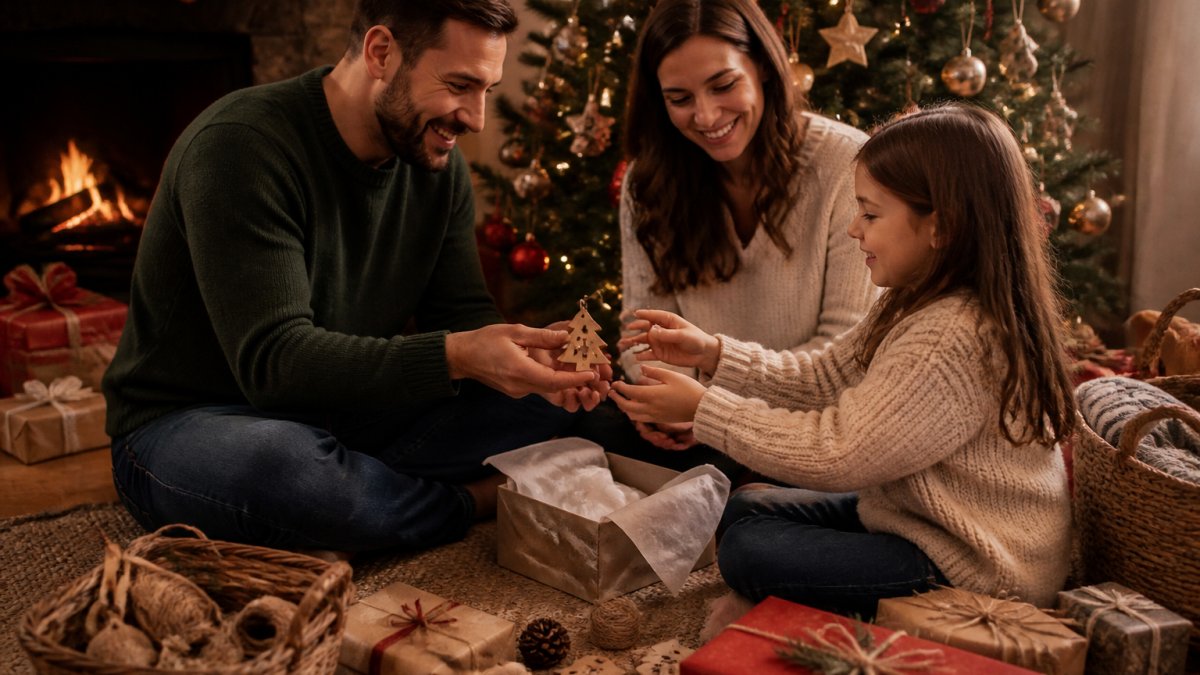
Here is how we would set it up:
- Choose a fixed date. The night you decorate the tree works well, before any ornaments go up.
- Give one ornament per family member. Not a pile. One piece gets remembered; ten get forgotten.
- Say the reason out loud. "This one is for the year you started kindergarten." Children remember the sentence longer than the object.
- Let each person hang their own. Even toddlers can manage a wooden ornament, and the ownership sticks.
- Write the year on the back. A fine-tip marker today saves a decade of guessing later.
Don't let the tradition become a shopping trip. The moment it turns into "go pick something at the mall," the meaning drains out and you are back to filler.
Choose Personalized Christmas Ornaments That Mark Milestones
Personalized Christmas ornaments turn a decoration into a record. A name, a date, or a short message engraved on wood tells a future reader exactly who this piece belonged to and why it exists. That is why we specialize in laser-engraved wooden pieces: the personalization is the point.
When you order a personalized ornament, check three things before you pay:
- Spelling. Makers engrave exactly what you type. Double-check unusual names, apostrophes, and dates.
- Material. Solid wood holds engraving cleanly for decades; thin composite board can chip at the edges.
- Preview. Ask whether you will see a proof before production. A good maker will show you the layout, not just take your money.
Our personalized name ornament is built for exactly this: any name, any spelling, cut and engraved to order.

First Christmas, New Baby, New Home: The Keepsakes That Matter Most
Some years deserve their own ornament. A baby's first Christmas, a first home, a wedding, a loss, these are the pieces families reach for first when the box comes out.
A few of our most-requested milestone pieces:
- Baby's First Christmas for new parents and grandparents. Engraved with the baby's name, it becomes a yearly marker of how fast the years went. You can order the baby's first Christmas keepsake directly.
- Our First Home for the couple who just closed on a house, engraved with their names.
- Just Married for newlyweds celebrating their first Christmas together, a piece that often becomes the center of the tree. The wedding couple ornament makes a strong gift for exactly that reason.
One honest note: our dog breed ornament covers pure breeds only, with no artwork for mixed breeds. If that is your situation, a name ornament is the better route.


Set a Collection Budget and Buy Gradually
A collection budget is a yearly spending cap you set before December, and the single best defense against impulse buying. A modest, fixed amount spent on one or two quality pieces beats a cart full of cheap ones every time.
Beginners treat the budget as a December number, but prices peak in November and December and the best small-maker pieces sell out by early fall. Set the cap in January, then spend against it across the year.
Here is a simple framework we recommend:
| Approach | Yearly Spend | What You Get | Best For |
|---|---|---|---|
| Starter | $30-$50 | 2-3 wooden ornaments | New collectors, young families |
| Steady | $50-$100 | 4-6 pieces, one milestone piece | Families adding a member |
| Milestone year | $100+ | A centerpiece plus small pieces | Weddings, births, first homes |
Pace the Spending Across the Year
A workable rhythm looks like this:
My Own Name Personalized Laser Cut Wood Ornament →
- January-February: Decide the year's milestone piece and set the cap. This is when you have the clearest view of what the year will hold.
- March-June: Order the centerpiece. Small engraving shops are quieter in spring, proofs come back faster, and you are not competing with the holiday rush.
- July-September: Fill in two or three smaller pieces. Craft fairs and maker markets run through the fall and are good places to find one-of-a-kind work.
That last rule saves the most money. Households already spend heavily in December; adding a pile of ornaments on top is how collections fill with filler.
Three Rules That Keep the Budget Honest
- One in, one out is not required, but one in, one story is. If you cannot say why a piece is joining the collection, it is not joining.
- Price per decade, not price per piece. A $40 wooden ornament kept for thirty years costs a little over a dollar a year. A $6 plastic piece replaced every other season costs more.
- Check the shipping threshold before checkout. If free shipping starts at $75 and your cart is at $60, either add a piece you already planned to buy or accept the shipping cost, do not add filler to hit the threshold.
Where and How to Source Ornaments Worth Keeping
Source from makers you can question, not anonymous listings with recycled photos. The difference shows up five years later, when one piece still looks new and the other has faded or chipped. Ask where the piece is made, what it is made of, and whether you can see the design before it ships.
The Five Main Sources, Compared
- Small engraving and woodworking shops. Best for personalized and milestone pieces. You can usually request a proof, ask about the wood species, and get a real answer about turnaround. Trade-off: smaller catalogs and seasonal cutoffs, many shops stop taking custom orders in early December.
- Craft fairs and holiday markets. Best for one-of-a-kind pieces and for meeting the person who made them. Trade-off: cash-and-carry, rarely any returns, and quality varies stall to stall. Ask what the finish is and whether it is sealed.
- Vintage and antique shops, estate sales, and flea markets. Best for character and for pieces with a history. Trade-off: condition risk. Check for cracks, missing caps, loose hangers, and repainting before you pay.
We are partial to small workshops: a maker who engraves to order will catch a misspelled name before it becomes firewood.
Questions to Ask Before You Pay
A few sourcing rules that hold up:
- Buy from makers who show real photos of finished pieces, not stock renders.
- Ask about returns before you order. Thirty-day returns tell you the maker stands behind the work.
- Buy the milestone piece first, then fill in around it. The centerpiece sets the tone.
Judging Condition on Vintage Pieces
If you are buying secondhand, a quick inspection saves money:
- Look at the cap and hanger first. Rust and looseness are the most common failure points.
- Check the paint at the edges. Chipping at the rim usually means the piece was stored loose in a box.
- Ask whether it has been repaired. A clean repair is fine; a hidden one is not.
How to Care for Christmas Ornaments Year After Year
Care for Christmas ornaments by handling them at the cap, not the body, and keeping them out of heat, sunlight, and damp. Most damage happens in the ten minutes of packing, not during the holiday itself.
Our working rules:
- Hold the hanger, not the ornament. Oils from fingers dull a finish over time.
- Dust with a soft brush, never a wet cloth on wood or hand-painted surfaces.
- Keep pieces out of direct sun. Fading is permanent.
Wooden ornaments are forgiving but not indestructible. A dry, stable closet beats a hot attic every time.
Christmas Ornament Storage Ideas That Protect Your Collection
The best Christmas ornament storage ideas share one principle: nothing touches anything else. Sort by type or occasion, wrap each piece, and label the box so next December is easy.
Start with these:
- Divided ornament boxes with individual compartments for fragile pieces.
- Resealable bags for small ornaments, one per bag, with the year written on the outside.
- Plastic containers with dividers for the rest, sorted by family member or occasion.
Sort by occasion as you pack: baby, wedding, travel, memorial. Next year you will decorate in a fraction of the time, and nothing fragile ends up under a stack of lights.
Catalog Your Collection So Nothing Gets Forgotten
A collection catalog is a simple list, photo, or spreadsheet recording what each ornament is, who it belongs to, and the story behind it.
Keep it simple: a notebook or a phone album with one photo per ornament and a caption.
The payoff is real: when a piece breaks, you know what to replace, and when the collection passes to the next generation, the meaning goes with it.
Building a Christmas ornament collection is not about spending more.
Frequently Asked Questions
How do you start a Christmas ornament collection from scratch?
Begin with one meaningful piece, such as a personalized Christmas ornament marking a milestone like a baby's first Christmas or a new home. Choose a theme or let the collection grow around your family's story. Set a modest budget, buy one or two ornaments each year, and store them carefully. Over time, the collection becomes a record of your life together.
What should you look for when buying collectible Christmas ornaments?
Look for solid materials like wood or glass, clean engraving or painting, and a sturdy hanging loop. Personalized Christmas ornaments with names and dates hold the most meaning. Check that the seller uses precise laser engraving and offers returns. Avoid ornaments with flimsy attachments or unclear personalization instructions, since mistakes are hard to fix once engraved.
How do you store Christmas ornaments safely?
Use ornament boxes with dividers or plastic containers lined with acid-free tissue. Wrap fragile glass ornaments in bubble wrap or resealable bags, and keep pieces separated by type. Store containers in a cool, dry place away from direct sunlight and extreme temperature swings. Label each box by occasion or family member so unpacking stays easy next season.
How can you make a Christmas ornament collection meaningful?
Tie each ornament to a specific memory: a trip, a birth, a wedding, or a loved one who has passed. Write the story on an index card and tuck it into the storage box. Add a personalized piece each year, and display favorites year-round on a small tree or ornament stand. The meaning comes from the stories, not the price.
How do you care for heirloom Christmas ornaments?
Handle wooden and glass ornaments by the hanging loop, not the body, to avoid wear. Dust gently with a soft brush, and avoid water on engraved wood. Store each piece in its own padded compartment, and keep fragile ornaments away from heat sources. Inspect the collection each year for loose hangers or cracks before decorating.

Leave a comment