

Last Updated: November 22, 2026
Quick Summary
To ship antique music boxes safely, first inspect and photograph the box, then let the spring run down fully and remove loose parts like the winding key. Wrap it in acid-free tissue and bubble wrap, and protect the glass dome, comb and corners. Pack it in a double box with at least 2 inches of cushioning.
- Photograph and record the box's condition before you wrap anything.
- Let the mainspring run down completely so it cannot release in transit.
- Wrap the winding key and discs separately, and keep them with the box.
- Never tape directly onto antique varnish, veneer or inlay.
- Double-box with at least 2 inches of cushioning on every side.
Table of Contents
- Assess Your Music Box and Note Its Condition Before Packing
- How to Pack Fragile Antiques for Shipping, Step by Step
- Best Packing Materials for Shipping Antiques
- Double-Boxing Fragile Items for Shipping
- Antique Music Box Shipping Insurance and Documentation
- Booking Your Shipment and Checking the Box on Arrival
- Frequently Asked Questions
Assess Your Music Box and Note Its Condition Before Packing
Before you wrap anything, take a careful look at your antique music box, because a clear record makes it easier to ship antique music boxes safely.
Start with a clear inspection. Check the case, the lid hinges, the glass or veneer, and the base. Look for cracks, loose joints, lifting veneer, and chipped corners. Then open it and check the movement.
Identifying Fragile Components: Comb, Cylinder, and Winding Key
Every music box has a few parts that take the most damage in transit. Know them before you pack.
- The cylinder: The brass or steel cylinder carries the pins that pluck the comb. Bent or missing pins mean the tune will not play.
- The comb: The tuned metal teeth are thin and easy to bend. Even a small bend throws off the sound.
- The winding key: Losing this key can make the box unusable until you find or replace it. Pack it separately and label it.
- The governor and spring: These control the playing speed. Do not wind the spring tight before shipping.
Take photos of each part from several angles. Note any sticking, rust, or sounds that seem off. Write it all down with the date. This record is your baseline.
How to Pack Fragile Antiques for Shipping, Step by Step
Packing takes more time than most people expect. Plan on an hour or more for a single music box, and longer for a glass-domed or disc model. Rushing is the most common cause of damage.
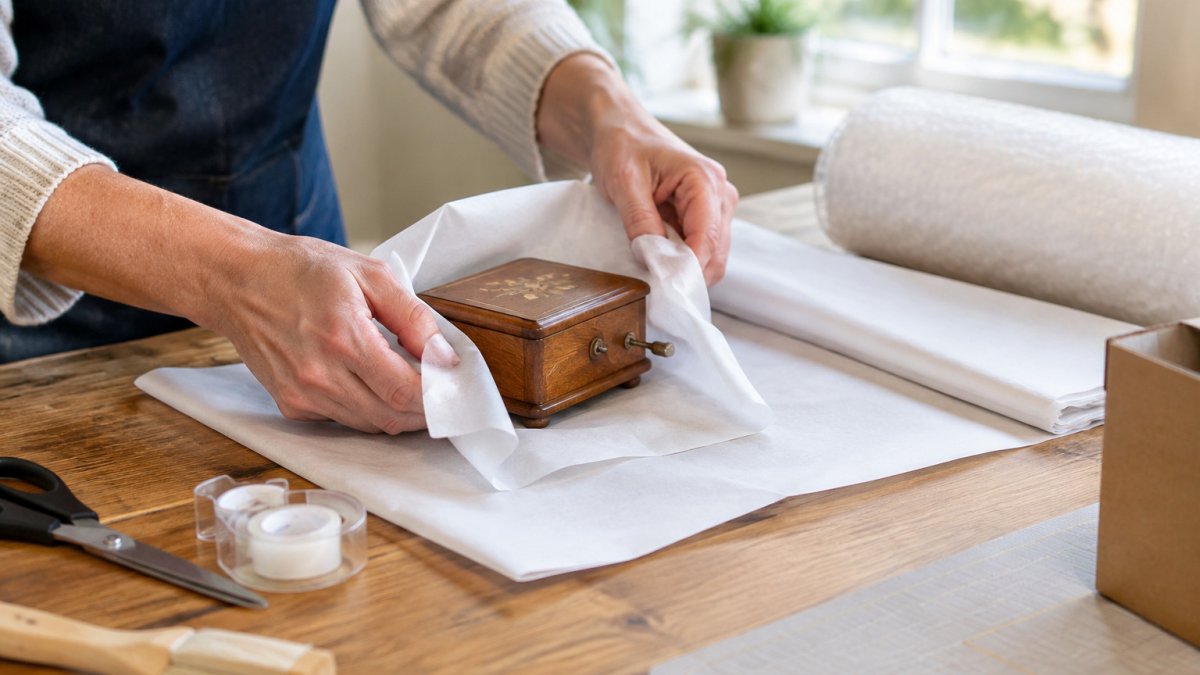
- Clean the outside gently. Use a soft, dry cloth. Avoid water and harsh cleaners on wood and finishes. Do not oil or lubricate the movement before shipping.
- Stop the movement without forcing it. Let the spring run down completely by playing the box until it stops on its own. Do not hold the cylinder still with your fingers while the spring is under tension, and do not jam a clip against the cylinder or comb. A wound spring that is suddenly released in transit can snap or strip the governor.
- Immobilize the cylinder the safe way. Once the spring is fully unwound, the cylinder should turn freely with light finger pressure. Cushion it from the outside: pack soft, lint-free tissue or a small foam block against the cylinder only if the manufacturer's case design allows it to sit without pressure on the pins. If you cannot reach the cylinder without dismantling the box, leave it alone and rely on external cushioning.
- Support the comb, do not press it. The comb teeth are tuned steel and bend permanently under light load. Do not wedge foam directly under the teeth. Instead, fill the air gap above the comb with a soft, uncompressed layer so the box cannot flex inward, and keep the lid latched so the comb cannot be struck from above.
- Remove loose parts. Take out the winding key, any small trays, disc magazines, and removable decorations. Wrap each one separately. On disc music boxes, remove and wrap the discs individually; a loose disc can act like a blade against the comb.
- Wrap the whole piece. Cover the box in acid-free tissue, then add a layer of small-bubble wrap. Tape the wrap closed, but do not tape directly onto the finish.
- Protect the corners and any protrusions. Add corner guards made of cardboard or foam. On glass-domed boxes, build a cardboard bridge over the dome so nothing rests on the glass.
- Seal the inner box. Place the wrapped box in a snug inner box and fill any gaps.
Watch out: Never tape directly onto antique varnish or veneer. Adhesive can lift the finish and cannot always be removed safely.
Packing by Music-Box Type and Construction
A single method does not fit every music box. Match your packing to the construction:
- Wooden cylinder boxes (the classic rectangular case): The main risks are lid-hinge stress and veneer lifting. Support the lid from underneath with tissue so the hinges are not carrying the lid's weight, and pad the base so the case cannot rock.
- Glass-domed boxes: The dome is the most fragile part and is usually not replaceable. Build a rigid cardboard cap over the dome before any wrap goes on, and pack the box so the dome faces up. Never lay a domed box on its side.
- Porcelain and ceramic cases: These crack at the base and around the winding aperture. Use foam corners and keep the box upright; do not rely on bubble wrap alone for shock absorption.
- Inlaid and marquetry cases: Inlay lifts when the surface flexes or when adhesive tape is applied. Use acid-free tissue only against the inlay, and avoid any pressure point over a decorative panel.
Securing the Mechanism and Removing Loose Parts
Before final wrapping, make sure the mechanism cannot move.
Let the mainspring run down completely first.
Check that the lid latch is closed and locked.
Keep all small parts together in one labeled bag and tape it inside the box, not outside.
Packing takes more time than most people expect, and the steps below show where a single box needs the most care.
| Step | What to do | Time or frequency |
|---|---|---|
| Clean the outside | Use a soft, dry cloth | Before packing |
| Stop the movement | Let the spring run down completely | Before packing |
| Immobilize the cylinder | Cushion from outside if case allows | Before packing |
| Support the comb | Fill air gap above comb; keep lid latched | Before packing |
| Remove loose parts | Wrap winding key and discs separately | Before packing |
| Wrap the whole piece | Acid-free tissue, then small-bubble wrap | Before packing |
| Protect corners | Add cardboard or foam corner guards | Before packing |
| Seal the inner box | Place in snug inner box and fill gaps | Before packing |
Best Packing Materials for Shipping Antiques
The right materials matter as much as the right technique. Here is what to gather before you start.
- Acid-free tissue paper: Protects finishes and does not stain.
- Bubble wrap: Use small-bubble wrap for detail and large-bubble wrap for cushioning.
- Rigid foam sheets or foam corners: Stop the box from shifting inside the carton.
- Double-wall cardboard boxes: Single-wall boxes often fail under pressure from stacking.
Avoid newspaper for the wrap. Ink can rub off on the finish.
Double-Boxing Fragile Items for Shipping
Double-boxing is the safest method when you ship antique music boxes. The inner box holds the item. The outer box absorbs impacts.
Choose an inner box that leaves about 2 inches of space on every side. Fill that space with cushioning. Then place the inner box inside a larger outer box, leaving at least 2 inches of cushioning between the two.
- Keep the inner box centered in the outer box.
- Fill every gap so the inner box cannot move when you shake it gently.
- Seal the outer box with H-taping across the seams and along all edges.
If the inner box moves when you shake it, you need more cushioning. Add material until it stays put.
Protecting Against Humidity and Temperature Swings
Moisture and temperature changes can warp wood, crack finishes, and rust metal parts. This is a risk most shipping guides skip.
Place a few silica gel packets inside the inner box to absorb moisture. Keep the box away from heat sources during transit where possible.
If the box must travel in cold or humid conditions, let it acclimate for several hours after delivery before you open it.
Antique Music Box Shipping Insurance and Documentation
Insurance protects the value of the box if it is lost or damaged. For antiques, the declared value should reflect what the item is worth, not what you paid for it years ago.
Establishing and Documenting Value
Gather these documents before you ship:
- Written appraisal or recent valuation from a qualified appraiser
- Photos of the box from all sides and of the mechanism, taken the same day you pack
- Your inspection notes from the first section, dated
- Original receipts or provenance records, if you have them
A written appraisal carries more weight than a self-declared value because it establishes a defensible number. If you do not have a current appraisal, a recent sale listing for a comparable model can support value, but note that carriers may discount it. Keep the appraisal and photos together in one file so you can produce them quickly if a claim is opened.
Carrier Limits and Antique Exclusions
Check the carrier's terms for antiques and fragile items, since coverage and declared-value rules vary by carrier. Ask whether they require special packaging, and keep proof that you followed it; a carrier can deny a claim if the packing did not meet its published standard.
If your box is worth more than a carrier's standard coverage, ask about declared-value options or a separate policy, and consider a specialist insurer for high-value pieces.
Building a Claim-Ready Record
Documentation only helps if it is complete and consistent. Photograph the box before packing, after packing, and after sealing the outer carton.
Carriers often require damage to be reported within a short window, so act quickly (File a Claim). Keep the original carton and all packing materials until the claim is resolved; inspectors may ask to see them.
Watch out: Save photos that show the cushioning and packing, not just the item.
Booking Your Shipment and Checking the Box on Arrival
When you book, choose a service with tracking and signature confirmation.
Photograph the outer box before you open it. Note any crushing, tears, or moisture stains.
Once the box is inside, unpack slowly. Compare the item with your pre-shipping photos and notes.
If you find damage, document everything before you handle the item further.
Ready to find a special piece for your home or a loved one?
Frequently Asked Questions
Are antique music boxes worth anything?
Some are, and value depends on the maker, age, condition, whether the original mechanism and cylinder are intact, and whether the case is original. Many music boxes are sold as decorative pieces with modest value, while signed examples from known makers in working order can be worth considerably more. Before shipping, have the box appraised or compared against auction records so you know what it is worth and can set an accurate insurance value. Pricing for your specific box depends on its condition and the current market, so a professional appraisal is the most reliable step.
Can you ship an antique music box through USPS?
Yes, you can ship an antique music box with USPS, but it has to be packed in a sturdy box with generous cushioning on all sides. Items of significant value should be sent with insurance or a tracked service, and you should mark the box fragile. Check the current USPS insurance limits and restrictions before you ship, since requirements can change. If the box is very large or heavy, a private carrier may be a better fit. Contact Grande Place for guidance on packing and repair-related shipments.
Should you remove the key or other detachable parts before shipping a music box?
Yes, remove the winding key and any loose or detachable parts and wrap them separately. Keep them in a small labeled bag and place that bag inside the outer box, not tucked into the music box case where they can shift and scratch the finish. Keeping the key separate also prevents it from pressing against the mechanism during transit. Note in your documentation that the parts were removed and packed separately so the recipient knows to look for them.
What is the safest way to ship an antique music box?
The safest method combines careful preparation with a sturdy double-boxed package. Document the box's condition with photos, secure the mechanism and remove loose parts, wrap the case in acid-free tissue, and cushion it with rigid foam or packed material on all sides inside a right-sized inner box. Place that inner box inside a larger outer box with at least two inches of cushioning, seal it well, and mark it fragile. Choose a carrier with tracking and insurance.

Leave a comment